International Day for the Abolition of Slavery
International Day for the Abolition of Slavery
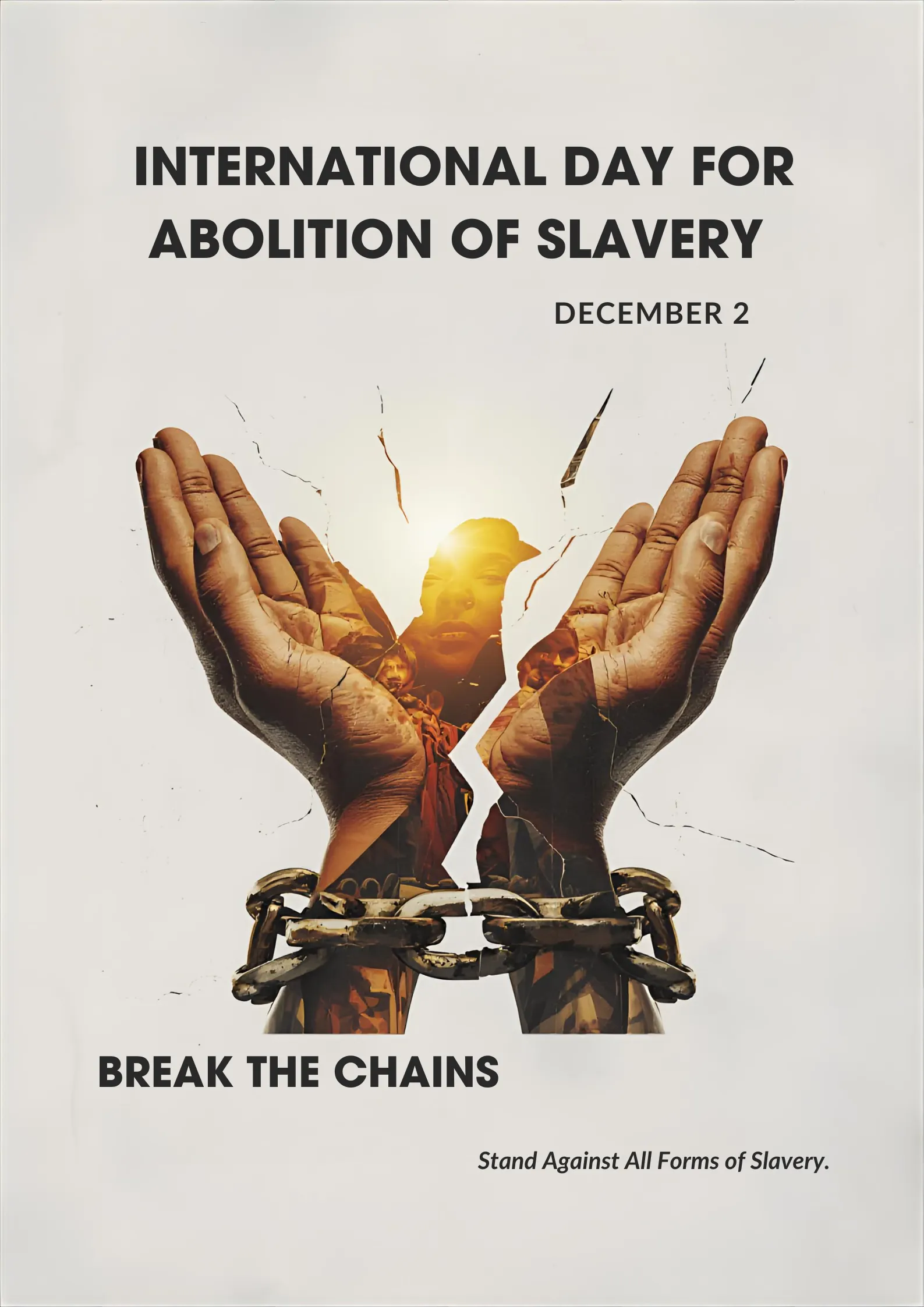
Slavery is often seen as a crime of the past. But today, millions of people are still trapped in situations where they cannot leave, refuse work, or control their own lives.
Every year on December 2, the world observes the International Day for the Abolition of Slavery. This United Nations observance focuses on ending modern slavery, including human trafficking, forced labour, child exploitation, debt bondage, and forced marriage.
The day reminds governments, institutions, and societies that although slavery has been legally abolished in most countries, it still exists in hidden and complex forms across the world.
Quick Facts
|
Aspect |
Details |
|
Observed on |
December 2 |
|
Proclaimed by |
United Nations General Assembly (1986) |
|
Historical basis |
1949 UN Convention for the Suppression of the Traffic in Persons |
|
Main focus |
Eradication of modern slavery |
|
Type of Event |
International Awarness Day |
|
Key issues |
Forced labour, human trafficking, forced marriage, and child labour |
|
Related SDG |
SDG Target 8.7 (End forced labour & human trafficking) |
|
Global estimate |
Around 50 million people are in modern slavery (ILO & UN, 2021) |
|
Purpose |
To raise global awareness about modern slavery, human trafficking, forced labour, child exploitation, and other forms of human rights abuse. |
|
Holiday Status |
Not a Public Holiday |
Historical Background
Origins of the Day
December 2 marks the adoption of the 1949 UN Convention for the Suppression of the Traffic in Persons and of the Exploitation of the Prostitution of Others. This was one of the first global agreements aimed at combating exploitation and human trafficking.
In 1986, the United Nations General Assembly officially proclaimed December 2 as the International Day for the Abolition of Slavery. The goal was not only to remember historical slavery but to address ongoing forms of exploitation worldwide.
Historical Slavery and Its Legacy
For centuries, slavery existed in many civilizations. The transatlantic slave trade alone forcibly transported millions of Africans to the Americas. Many countries abolished slavery in the 19th and early 20th centuries, yet the economic inequality, racial discrimination, and social injustice created by those systems still affect societies today.
Understanding this history helps explain why modern forms of slavery often target vulnerable and marginalized communities.
What Is Modern Slavery?
Modern slavery is an umbrella term used to describe situations where individuals are exploited and cannot leave due to threats, violence, coercion, deception, or abuse of power.
Unlike historical slavery, it may not always involve visible chains. Instead, control is often psychological, financial, or legal.
Major Forms of Modern Slavery
- Forced Labour – People are forced to work under threats or deception, often with little or no pay.
- Human Trafficking – Individuals are recruited, transported, or harbored for exploitation.
- Debt Bondage – Workers are trapped by debts that they cannot realistically repay.
- Forced or Early Marriage – Individuals are compelled into marriage without free consent.
- Child Labour and Exploitation – Children are forced into harmful work or recruited into armed groups.
According to the International Labour Organization (ILO) and the United Nations, modern slavery exists in nearly every country, whether as a source, transit, or destination.
Global Scale of Modern Slavery
Modern slavery remains a serious global issue.
The latest joint estimates from the ILO, International Organization for Migration (IOM), and Walk Free (2021) show:
-
Around 50 million people are living in modern slavery.
-
Approximately 28 million people are in forced labour.
-
Around 22 million people are in forced marriage.
-
Women and girls account for a significant proportion of those affected.
-
Children represent a concerning share of forced labour cases.
Forced labour occurs in industries such as agriculture, construction, domestic work, manufacturing, mining, and fishing. Some exploitation also happens within global supply chains, where demand for cheap labor increases vulnerability.
Modern slavery generates billions of dollars in illegal profits every year, making it one of the most profitable forms of organized crime globally.
Causes and Risk Factors
Modern slavery is driven by a combination of social, economic, and political factors.
Key Causes Include:
- Poverty and unemployment – Desperation increases vulnerability.
- Armed conflict and displacement – Refugees and migrants face high risks.
- Gender inequality – Women and girls are disproportionately affected.
- Weak legal systems and corruption – Poor enforcement allows exploitation to continue.
- Demand for cheap goods and services – Economic pressure in global markets can encourage unethical labour practices.
These factors often overlap, making prevention complex and requiring international cooperation.
Role of the United Nations and International Frameworks
The United Nations plays a central role in coordinating global efforts to eliminate slavery.
Key Legal Instruments
-
1949 Convention against trafficking and exploitation.
-
1956 Supplementary Convention on the Abolition of Slavery.
-
Palermo Protocol (2000) to prevent, suppress, and punish trafficking in persons.
-
ILO Forced Labour Convention and 2014 Protocol, which strengthen protections against forced labour.
Sustainable Development Goals
Ending modern slavery is part of the 2030 Agenda for Sustainable Development.
Target 8.7 specifically calls for immediate and effective measures to eradicate forced labour, end modern slavery and human trafficking, and eliminate child labour in all its forms.
UN Agencies Involved
-
International Labour Organization (ILO) – Data collection and labour standards.
-
UN Office on Drugs and Crime (UNODC) – Focus on trafficking and criminal justice.
-
UNICEF – Child protection initiatives.
-
Human Rights Council – Monitoring and reporting human rights violations.
These agencies work with governments and civil society to improve laws, strengthen enforcement, and support victims.
Observance and Global Awareness
The International Day for the Abolition of Slavery is observed worldwide through:
-
Educational discussions on human rights and exploitation
-
Academic research presentations
-
Government statements and policy reviews
-
Media coverage highlighting modern slavery issues
The observance serves as a reminder that legal abolition alone is not enough. Effective implementation, awareness, and accountability remain essential.
Ongoing Challenges
Despite international agreements, challenges remain:
-
Hidden and informal labour markets
-
Limited data in some regions
-
Online recruitment and digital exploitation
-
Climate change is increasing migration risks
-
Inconsistent law enforcement across countries
These challenges show that modern slavery is not a single issue but a complex global problem linked to development, migration, inequality, and governance.
The International Day for the Abolition of Slavery, observed on December 2, highlights both historical injustice and present-day exploitation. While slavery has been legally abolished in most nations, modern slavery continues to affect millions through forced labour, human trafficking, and forced marriage.
Ending modern slavery requires strong laws, international cooperation, economic fairness, and sustained global commitment. The observance reminds the world that freedom and dignity must be protected not only in principle, but in practice.